Common Questions Of 210 Type Two-stage Plastic Pelletizing Machine
Most customers have doubts about application scenarios, configuration advantages, energy noise, compliance standards and maintenance when purchasing and using the 210 type two-stage plastic pelletizing machine. Combined with years of equipment R&D, manufacturing and on-site service experience, this article sorts out high-frequency industry FAQ questions, and comprehensively explains core performance and operation essentials of this hot-selling plastic pelletizing machine, helping customers select models and put into production efficiently.
FAQ1: What are the core configuration advantages of 210 type two-stage plastic pelletizing machine?
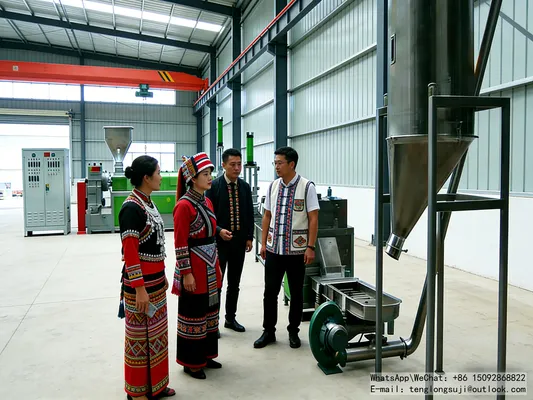
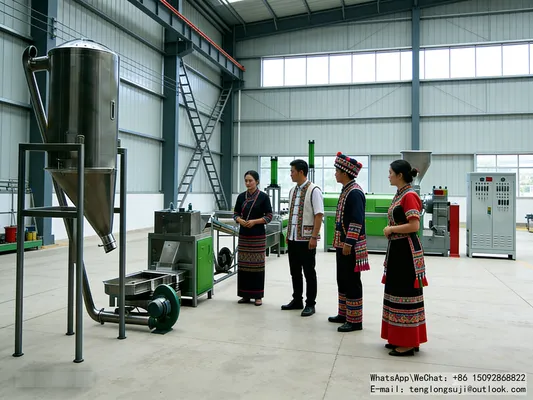
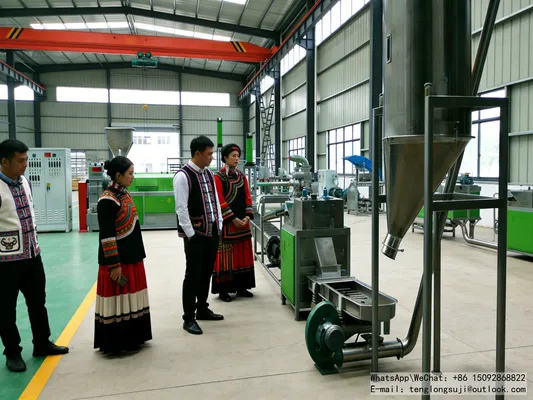
A: This plastic pelletizing machine has four core advantages: wear resistance, low noise, high automation and energy saving. Core extrusion parts adopt 210mm 40CR high-frequency screw and 273mm 45# steel high-frequency barrel, featuring wear resistance, high temperature resistance and long service life. It is equipped with 200 type thickened feeding reducer + 315 type low-noise hard tooth surface reducer, with stable transmission and ultra-low noise. Standard 400*400mm hydraulic automatic screen changing head and 4KW independent pump station realize non-stop screen changing with high automation. The split heating system including 80KW electromagnetic main heating + 60KW secondary heating ring realizes zoned temperature control and high energy efficiency, with comprehensive performance better than ordinary machines of the same specification.
FAQ2: What scale of factories is the 210 type two-stage plastic pelletizing machine suitable for, and what is its capacity?
A: Designed for startup and small-medium plastic recycling factories, this plastic pelletizing machine fits factories with limited site, fewer workers and daily capacity demand of 4-6 tons. It also supports self-used pelletizing of plastic factory scraps and runner materials. Featuring compact body, small floor space, simple operation and unattended operation, it is stable for long-term lightweight regular production, not suitable for large-scale super-high-capacity production lines.
FAQ3: What practical benefits does hydraulic automatic screen changing bring compared with traditional manual screen changing?
A: Traditional manual screen changing requires shutdown, disassembly, screen installation and sealing, which is time-consuming, low-efficiency, easy to cause material leakage and raw material loss, leading to unstable particle batch quality. The hydraulic screen changing system of 210 type plastic pelletizing machine realizes fast non-stop automatic screen changing without manual intervention. It improves screen changing efficiency by more than 60%, reduces shutdown loss, ensures stable melt filtration precision, upgrades finished particle quality, cuts labor cost, and brings obvious long-term production benefits.
FAQ4: Do the noise and energy consumption meet environmental production standards?
A: It fully meets domestic industrial environmental protection assessment standards. Equipped with 315 type hard tooth surface low-noise reducer with precise transmission structure, the measured operating noise is below 73dB without high-frequency abnormal noise. Adopting energy-saving electromagnetic heating and zoned temperature control technology, the heating system has high heat utilization rate, saving about 30% energy compared with traditional plastic pelletizing machine. It has no invalid energy consumption and low carbon emission, which can pass factory environmental inspection smoothly.
FAQ5: Can particles produced by this machine meet EU PPWR export compliance requirements?
A: Fully compliant. Certified by third-party compliance inspection, this plastic pelletizing machine adopts precise segmented plasticization and high-precision hydraulic filtration technology. The produced recycled particles have few impurities, high purity and strong plasticity, with recyclability ≥70%, meeting the 2030 EU PPWR Packaging Waste Regulation market access standards. It is widely used for export-grade recycled plastic raw material production, adapting to both domestic and foreign trade orders.
FAQ6: Is daily maintenance difficult? What is the whole machine service life?
A: Adopting modular simplified structure, the machine is easy to maintain, and new operators can get started quickly. Daily maintenance only includes cleaning residual materials on screw and barrel regularly, checking reducer lubrication status and calibrating heating temperature, without complex maintenance procedures. Core parts are strengthened by high-frequency heat treatment. Under standardized use, the whole machine service life is more than 8 years, and wearable parts including screw and barrel can serve more than 5 years with ultra-low maintenance cost.
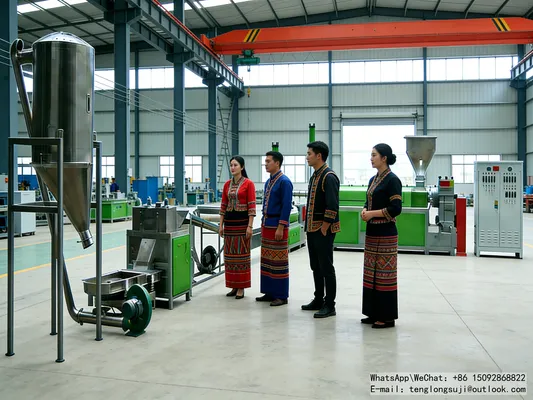
Free Consultation CTA
Still confused about model selection, production commissioning and equipment maintenance? If you need detailed quotation, accurate capacity calculation, raw material matching scheme and complete after-sales guarantee, feel free to contact us for free consultation. Professional engineers provide one-on-one service and customized exclusive production solutions.
Contact: WhatsApp/Wechat: +86 15092868822 | Email: [email protected]