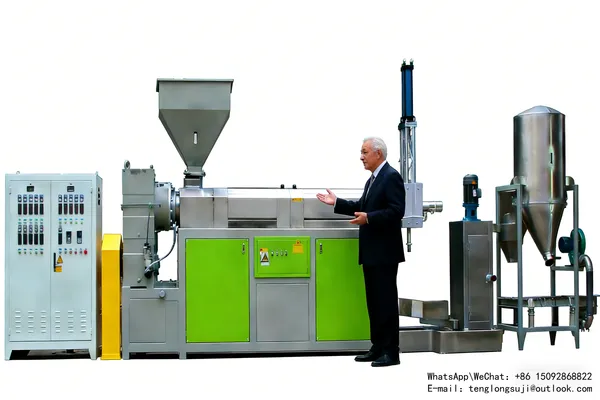
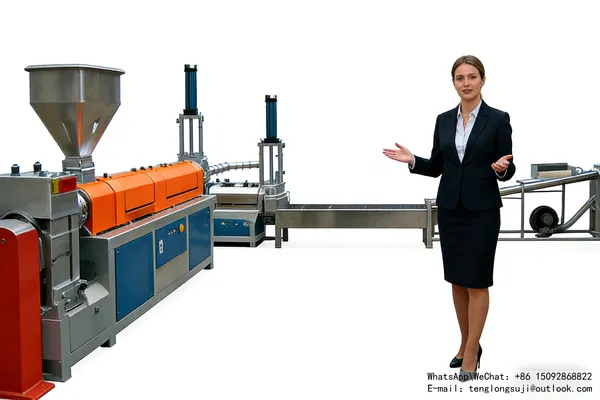
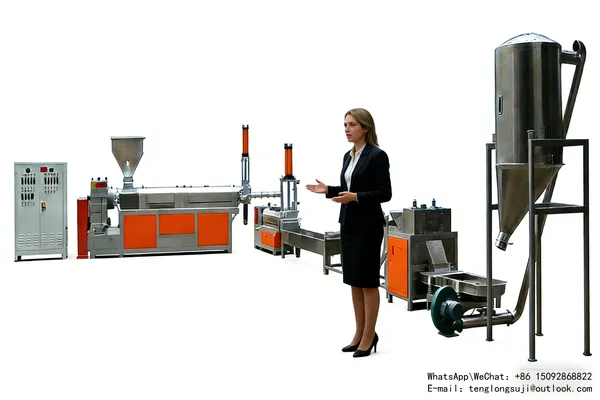
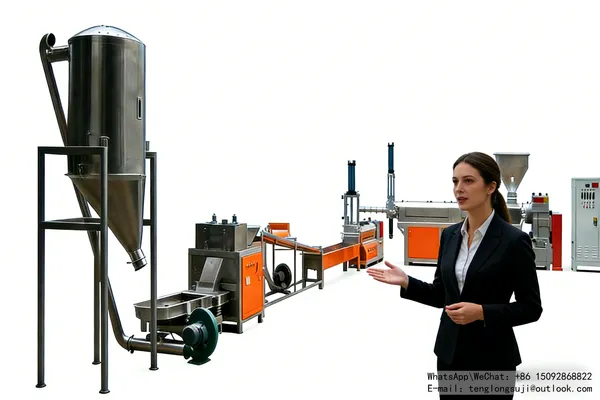
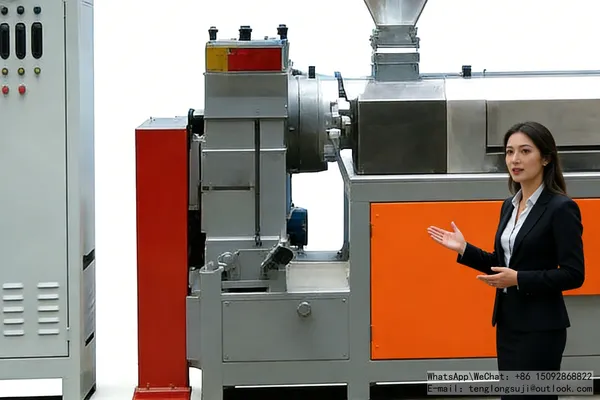
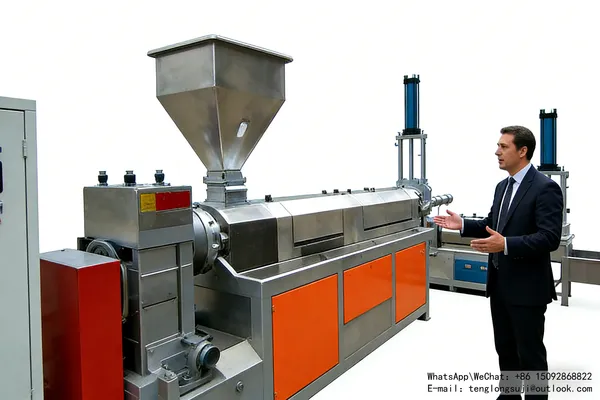
Background: Mr. Jun, a 40-year-old vocational school graduate, operates a small plastic recycling workshop in Quezon City with 6 employees. His workshop primarily processes PP/PE packaging waste from local food processing factories and retail stores—Quezon City’s thriving food industry generates over 2,000 tons of plastic packaging waste monthly. Mr. Jun launched his business in 2019 to support his family after losing his job in a local factory. He initially used a second-hand Plastic granulator, but its high energy consumption and low efficiency made it difficult to turn a profit, especially amid the Philippines’ rising electricity prices (PHP 12.50/kWh in 2026).
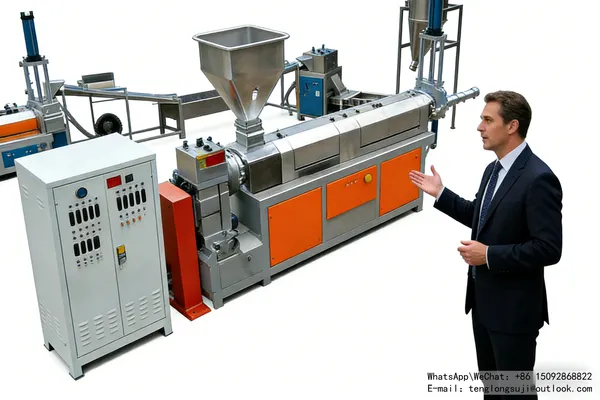
Plastic granulator
The Challenge
Mr. Jun faced three main obstacles. First, his old small-scale Plastic granulator consumed 85 kWh per ton of plastic—far exceeding the industry average of 65 kWh—inflating his monthly electricity costs by PHP 37,500. Second, the machine’s single vacuum exhaust system failed to remove volatile gases from printed PP/PE packaging, leading to black spots in 18% of the granules, which could only be sold at PHP 25/kg. Third, the granulator’s manual feeding system struggled with lightweight PP/PE packaging, causing feeding jams and reducing output to 180 kg/h. He could not afford expensive imported equipment and needed a cost-effective, energy-saving PP/PE Plastic granulator suitable for his small workshop.
The Solution
We customized a TL-100 Plastic granulator for Mr. Jun’s small workshop, optimized for Quezon City’s PP/PE packaging waste and his budget constraints:
- An energy-saving motor with frequency conversion technology, reducing unit energy consumption to 60 kWh per ton—a 29.4% reduction—saving PHP 46,875 monthly on electricity.
- A dual-position vacuum exhaust system, effectively removing volatile gases from printed PP/PE packaging and eliminating black spots in the granules.
- An automatic feeding system with adjustable speed, solving the problem of lightweight PP/PE packaging feeding jams and ensuring stable feeding.
- A compact design, ideal for small workshops (occupying only 8 square meters), with easy access for maintenance and raw material transportation.
- An affordable price point (30% cheaper than imported models) with a 1-year warranty and free spare parts for 6 months, plus local after-sales support in Quezon City.
Our team provided on-site installation and training for Mr. Jun and his employees, teaching them how to optimize the machine’s performance and pre-process PP/PE packaging waste to further improve granule quality. We also shared tips on reducing energy consumption, helping him cut costs even more.
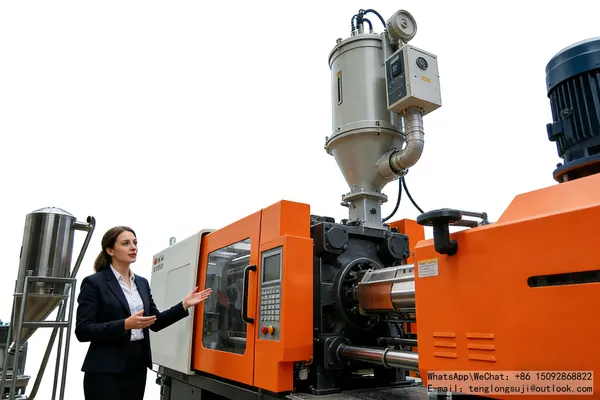
Plastic granulator
The Results
After 2 months of operation, the TL-100 Plastic granulator transformed Mr. Jun’s workshop: 1. Unit energy consumption reduced by 29.4%, saving 25 kWh per ton of plastic and PHP 46,875 monthly on electricity. 2. Feeding efficiency improved by 77.8%, increasing output from 180 kg/h to 320 kg/h—doubling daily production. 3. 99% of the granules were free of black spots, meeting injection molding grade standards, allowing him to raise the selling price to PHP 42/kg, increasing monthly profit by PHP 1,382,400. 4. The machine is easy to operate and maintain, reducing maintenance costs by 45% compared to his old second-hand machine. “This Plastic granulator is energy-saving, affordable, and efficient—it’s a lifesaver for my small workshop. I can now support my family comfortably and even plan to hire more employees,” said Mr. Jun.
FAQ
Q1: Is this Plastic granulator suitable for small workshops in Quezon City? A1: Yes, its compact design (8 square meters) and low power consumption make it ideal for small-scale operations with 5-10 employees. Q2: Can it process printed PP/PE packaging waste without black spots? A2: Yes, the dual-position vacuum exhaust system removes volatile gases, ensuring 99% of granules are free of black spots. Q3: How much can I save on electricity costs with this machine? A3: It reduces unit energy consumption by 29.4%, saving approximately PHP 46,875 monthly for a small workshop processing 5 tons of plastic waste.
If you have a small plastic recycling workshop in Quezon City and struggle with high energy costs or black spots in granules, let us know in the comments!