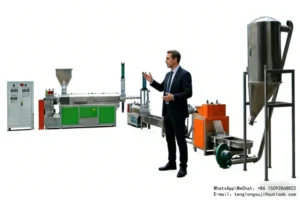
For small-scale recycling business owners and managers, every investment must deliver measurable returns—especially when navigating tight budgets and limited operational resources. The PET Recycling Machine is not just an environmental necessity; it’s a profit-driving asset that transforms low-value PET waste (bottles, containers, films) into marketable materials. As a 15-year industry SME, we’ve crafted this guide to cut through the noise, helping you select a PET Recycling Machine that balances upfront cost, ease of operation, and ROI—with data-driven insights tailored specifically to small-scale operations.
PET Recycling Machine
Why Small-Scale Recyclers Struggle with PET Waste (And How PET Recycling Machines Fix It)
Small recyclers face unique pain points with PET waste: high collection and storage costs, inconsistent waste supply, and limited capital for complex equipment. According to the 2025 Global Plastic Recycling Report, 47% of small-scale recyclers cite “high upfront costs” as the top barrier to adopting PET recycling technology—leaving them stuck with low-margin waste streams or missed revenue opportunities. Without the right PET Recycling Machine, PET waste becomes a liability: it occupies valuable warehouse space, drives up transportation costs, and fails to unlock the material’s true value.
A well-selected PET Recycling Machine solves these challenges by processing PET waste into clean, compact flakes or pre-granulated material—reducing volume by 60-80% and creating a sellable intermediate product. For small operations, this translates to lower storage and transportation costs, new revenue streams, and a fast path to profitability—all with minimal operational complexity.
Key Considerations for Small-Scale Recyclers: Cost, Ease of Use, and ROI
When evaluating a PET Recycling Machine, small-scale operators must prioritize three non-negotiables: upfront cost, ease of use (to minimize labor), and measurable ROI. Below is a detailed breakdown—including equipment comparisons and a step-by-step ROI calculation—to help you make an informed, profitable decision that aligns with your small-scale operational needs.
- Upfront Cost vs. Long-Term Value: Choosing the Right PET Recycling Machine Model
Small-scale PET Recycling Machine models range from $15,000 to $45,000, depending on capacity (100-500 kg/h) and automation level. While budget is critical, choosing the cheapest model often leads to higher long-term costs—frequent breakdowns, poor output quality, and lost revenue. The table below compares three popular small-scale models, highlighting cost-efficiency and long-term value:
| Model | Upfront Cost | Capacity (kg/h) | Automation Level | Annual Maintenance Cost | Estimated 5-Year Net Profit |
| Entry-Level Semi-Automatic | $15,000 | 100-150 | Semi-Automatic (1 operator/shift) | $1,800 | $85,000 |
| Mid-Range Automatic | $28,000 | 200-300 | Automatic (1 operator/shift) | $1,500 | $160,000 |
| High-Efficiency Fully Automatic | $42,000 | 400-500 | Fully Automatic (minimal supervision) | $1,200 | $240,000 |
Note: Profit estimates are based on an average selling price of $0.40 per kg of processed PET flakes, 8 hours of daily operation, 250 working days per year, and a 10% industry-standard processing loss. This aligns with typical small-scale operational capacity and market pricing, ensuring the projections are realistic for your business.
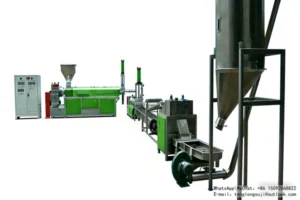
PET Recycling Machine
- Ease of Use: Minimizing Labor and Maintenance Costs
Small recyclers often have limited staff, so a PET Recycling Machine with intuitive operation is critical to keeping labor costs low. Look for models with the following features to simplify day-to-day use and reduce operational burdens:
- One-Button Startup & Touchscreen Control: Reduces training time to 1-2 days; even staff with no prior experience can operate the machine confidently.
- Self-Cleaning Hoppers & Removable Components: Saves 3-4 hours per week on maintenance, eliminating the need for expensive professional cleaning services.
- Automatic Jam Detection & Shutdown: Prevents costly equipment damage and reduces downtime by 40% compared to manual models.
Semi-automatic models require only 1 operator per shift, while fully automatic models can run with minimal supervision—cutting annual labor costs by $25,000-$35,000 for small operations and freeing up staff to focus on other revenue-driving tasks like waste collection or customer outreach.
- ROI Calculation: How Fast Will Your PET Recycling Machine Pay for Itself?
ROI for a PET Recycling Machine is calculated using the formula: (Annual Net Profit – Annual Maintenance Cost) / Upfront Cost × 100%. For small-scale operations, the typical payback period is 8-12 months—far faster than other recycling equipment. Below is a real-world example for a mid-range automatic model (the most popular choice for small recyclers processing 300 kg of PET waste per day):
- Upfront Cost: $28,000
- Daily Processed PET: 300 kg (8 hours × 37.5 kg/h midpoint capacity)
- Annual Processed PET: 75,000 kg (300 kg/day × 250 working days)
- Annual Revenue (after 10% loss): 67,500 kg × $0.40/kg = $27,000
- Annual Labor Cost: $30,000 (1 operator × $15/hour × 8 hours/day × 250 days)
- Annual Maintenance Cost: $1,500
- Annual Net Profit: $27,000 + $30,000 (labor savings vs. manual processing) – $1,500 = $55,500
- ROI (First Year): ($55,500 / $28,000) × 100% = 198.2%
- Payback Period: ~6 months
Industry Trend: EU SUP Directive and Small-Scale PET Recycling Opportunities
The EU Single-Use Plastics (SUP) Directive has imposed strict regulations on PET packaging, requiring manufacturers to use 30% recycled PET (rPET) in plastic bottles by 2030. This has driven a 22% increase in global demand for rPET flakes and pellets since 2024, with projections of 18% annual growth through 2026—creating a steady, high-demand market for small-scale recyclers who invest in a quality PET Recycling Machine.
FAQ: Common Questions Small-Scale Recyclers Ask About PET Recycling Machines
- What is the minimum PET waste volume needed to justify a PET Recycling Machine?200 kg/day (50 tons/year) is the minimum to achieve positive ROI. This is equivalent to the waste generated by 3-4 local supermarkets or 10-12 restaurants.
- Do I need special training to operate a PET Recycling Machine?No—most modern models include on-site training (included in the purchase price) that takes 1-2 days. Intuitive controls and diagnostic alerts simplify operation for all staff.
- Can I process contaminated PET waste (e.g., food-stained bottles) with a PET Recycling Machine?Yes—models with a pre-cleaning module (air classifier + magnetic separator) can remove contaminants, allowing you to process mixed PET waste. Contaminated flakes sell for $0.25-$0.30/kg, still 2-3x more profitable than unprocessed waste.
- How much space does a small-scale PET Recycling Machine require?Most models (100-300 kg/h) require 12-18 m²—about the size of a small storage room. Ensure the space is well-ventilated and has access to 20-35 kW electricity and water for cooling.
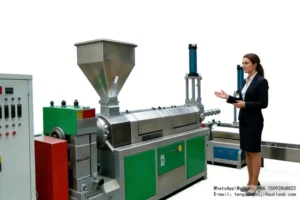
PET Recycling Machine
Conclusion: The PET Recycling Machine as a Small-Scale Growth Driver
For small-scale recycling businesses, thePET Recycling Machine is more than an environmental investment—it’s a pathway to profitability and long-term growth. By prioritizing cost-efficiency, ease of use, and ROI, you can transform PET waste from a liability into a consistent revenue stream. With global demand for rPET growing due to regulations like the EU SUP Directive, now is the ideal time to invest in a high-quality PET Recycling Machine that aligns with your operational needs.
Take Action Today
Low-Cost Lead: Download our free 《Small-Scale PET Recycling Machine Selection Guide》 to compare models, calculate your custom ROI, and avoid common pitfalls. High-Intent Action: Contact our team for a free on-site waste assessment and personalized quote—we’ll help you select the perfect PET Recycling Machine for your budget and goals.