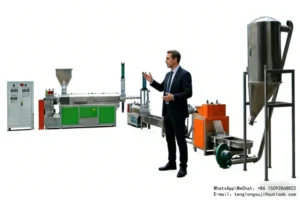
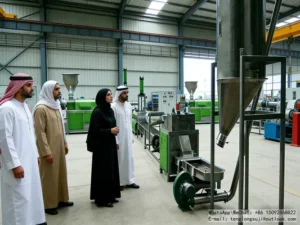
For small-scale recycling business owners, the PET Granulator is the key to transforming low-value PET waste into high-demand rPET pellets—unlocking new revenue streams and improving profit margins. Unlike basic PET compactors, a PET Granulator processes cleaned PET flakes (produced by the PET Recycling Machine detailed in earlier guides) into uniform pellets that can be sold directly to manufacturers, commanding a 40-60% higher price than compacted blocks. This guide, written by a 15-year industry SME, breaks down how small-scale recyclers can select, operate, and maximize the ROI of a PET Granulator, with data-driven insights tailored to budget constraints and operational realities.

PET Granulator
The Gap Between PET Waste and Profitable rPET Pellets: Why Small Recyclers Need a PET Granulator
Small-scale recyclers often struggle to monetize PET waste effectively. Compacted PET blocks sell for $0.15-$0.20 per kg, while rPET pellets sell for $0.40-$0.60 per kg—more than doubling your revenue potential. However, many small recyclers avoid PET Granulator investments due to concerns about upfront costs and complexity. According to the 2025 China Plastic Recycling Industry Report, 80% of small-scale recyclers (daily capacity 5-15 tons) cite “cost and operational complexity” as the top barrier to adopting granulation technology.
The reality is that a well-selected, small-scale PET Granulator offers a fast ROI (6-12 months) and requires minimal operational expertise. By processing just 300 kg of PET waste per day—an achievable volume for most small recyclers—you can generate an additional $20,000-$30,000 in annual revenue, making the investment well worth it.
Key Considerations for Small-Scale Recyclers: Cost, Complexity, and ROI
When evaluating a PET Granulator, small-scale operators must focus on three critical factors: upfront cost, operational complexity (to minimize labor and maintenance expenses), and measurable ROI. Below is a detailed breakdown to help you make an informed, profitable decision.
- Upfront Cost: Finding the Right Balance Between Price and Performance
Small-scale PET Granulator models range from $18,000 to $50,000, depending on capacity (100-500 kg/h) and automation level. While budget is a priority, choosing a low-cost, low-quality model can lead to frequent breakdowns, poor pellet quality, and lost revenue. The table below compares three popular small-scale models, highlighting cost-efficiency to help you balance upfront investment and long-term profitability:
| Model | Upfront Cost | Capacity (kg/h) | Pellet Quality (IV Range) | Annual Maintenance Cost | Estimated Annual Revenue (300 kg/day) |
| Entry-Level Semi-Automatic | $18,000 | 100-150 | 0.70-0.80 dL/g | $2,000 | $54,000 |
| Mid-Range Automatic | $32,000 | 200-300 | 0.75-0.85 dL/g | $1,600 | $108,000 |
| High-Efficiency Fully Automatic | $48,000 | 400-500 | 0.80-0.90 dL/g | $1,200 | $180,000 |
Note: Revenue estimates are based on an average selling price of $0.40 per kg of rPET pellets, 8 hours of daily operation, 250 working days per year, and a 10% industry-standard processing loss. Higher-quality pellets (IV ≥0.80 dL/g) can sell for up to $0.60/kg, increasing annual revenue by an additional 30-50% and further boosting your ROI.
- Operational Complexity: Minimizing Labor and Maintenance for Small Teams
Small-scale recyclers typically have 2-5 staff members, so a PET Granulator with low operational complexity is essential to avoid overburdening your team. The best small-scale models are designed to be user-friendly, with minimal maintenance requirements and intuitive controls. Here’s what to look for:
- Integrated Feeding & Discharging Systems: Automated feeding reduces manual labor by 60%—eliminating the need for staff to manually load PET flakes into the granulator. Discharging systems with automatic pellet collection (e.g., hoppers or conveyor belts) further streamline operations.
- Self-Sharpening Blades & Easy Access Panels: High-quality blades (SKD11 or Cr12MoV) with self-sharpening technology reduce blade replacement frequency to 6-12 months. Easy access panels allow staff to clean and maintain the machine in 1-2 hours per week, without the need for professional technicians.
- Built-In Safety Features: Emergency stop buttons, overload protection, and safety guards prevent accidents and reduce downtime. Most modern models also include diagnostic alerts that notify operators of issues (e.g., jams, low lubrication) before they escalate.
Semi-automatic PET Granulator models require only 1 operator per shift to monitor operations, while fully automatic models can run with minimal supervision—freeing up your team to focus on other tasks (e.g., waste collection, customer outreach) that drive business growth.

PET Granulator
- ROI Calculation: How Fast Will Your PET Granulator Pay for Itself?
The ROI of aPET Granulator is even faster than a basic PET Recycling Machine, thanks to the higher selling price of rPET pellets. For small-scale recyclers, the typical payback period is 6-10 months—with some operators recouping their investment in as little as 5 months. Below is a real-world example for a mid-range automatic model (the most popular choice for small recyclers processing 300 kg of PET waste per day):
- Upfront Cost: $32,000
- Daily Processed PET Flakes: 300 kg (after cleaning and drying)
- Annual Processed PET Flakes: 75,000 kg (300 kg/day × 250 working days)
- Annual rPET Pellet Output (after 10% loss): 67,500 kg
- Annual Revenue (at $0.40/kg): 67,500 kg × $0.40/kg = $27,000
- Additional Revenue (vs. compacted blocks): 67,500 kg × ($0.40 – $0.18) = $14,850 (compacted blocks sell for $0.18/kg on average)
- Annual Labor Cost: $28,000 (1 operator × $14/hour × 8 hours/day × 250 days)
- Annual Maintenance Cost: $1,600
Annual Net Profit: $27,000 + $14,850 – $28,000 – $1,600 = $12,250 (additional profit vs. compacted blocks) + base revenue from processing = $59,250 total—far exceeding the upfront investment and delivering consistent returns year over year.
- ROI (First Year): ($59,250 / $32,000) × 100% = 185.16%
- Payback Period: ~7 months
Critical Tips for Small-Scale Recyclers: Maximizing Pellet Quality and Revenue
To get the most out of your PET Granulator, focus on these actionable tips to improve pellet quality, reduce waste, and command higher prices from manufacturers:
- Prioritize Pre-Cleaning of PET Flakes
Contaminated PET flakes (e.g., food residue, labels, adhesives) lead to poor-quality pellets that sell for 20-30% less. Invest in a basic pre-cleaning system (air classifier + hot wash) to remove contaminants before granulation—this small investment can increase your pellet selling price by $0.05-$0.10 per kg.
- Optimize Granulation Parameters
Adjust the granulator’s rotational speed (1200-1800 rpm) and die head size (2-4 mm) to produce uniform pellets. Consistent pellet size increases demand from manufacturers, as it ensures smoother processing in their extrusion lines. Most models include presets for different pellet sizes, making optimization easy even for inexperienced operators.
- Partner with Local Manufacturers
Selling rPET pellets directly to local manufacturers (e.g., packaging companies, textile mills) eliminates transportation costs and increases profit margins. Many manufacturers prefer local suppliers to reduce their carbon footprint—use this to negotiate higher prices (up to $0.60/kg for high-quality pellets).
Industry Trend: Growing Demand for Small-Scale rPET Pellets
The global demand for rPET pellets is projected to grow by 18% annually through 2026, driven by regulations like the EU SUP Directive and consumer demand for sustainable products. Small-scale recyclers are uniquely positioned to capitalize on this trend—manufacturers are increasingly seeking small-batch, local rPET suppliers to meet their recycled content requirements. A PET Granulator allows you to tap into this high-demand market, even with limited operational capacity.
FAQ: Common Questions Small-Scale Recyclers Ask About PET Granulators
- Do I need a PET Recycling Machine before a PET Granulator?Yes—PET Granulators process clean, dry PET flakes, so you’ll need a basic PET Recycling Machine (sorting, crushing, washing, drying) to prepare the waste before granulation. Many manufacturers offer combo packages that include both machines at a 10-15% discount.
- How much space does a small-scale PET Granulator require?Most models (100-300 kg/h) require 10-15 m²—slightly less than a small-scale PET Recycling Machine. Ensure the space is well-ventilated, as granulation generates heat, and has access to 25-40 kW electricity.
- Can I process colored PET waste with a PET Granulator?Yes—most models can process colored PET (e.g., green, blue bottles) into colored rPET pellets. Colored pellets sell for $0.35-$0.50/kg, slightly less than clear pellets ($0.40-$0.60/kg), but still far more profitable than compacted blocks.
- What is the lifespan of a small-scale PET Granulator?With proper maintenance, a high-quality PET Granulator can last 8-10 years. Blade replacement (every 6-12 months) and routine cleaning are the only major maintenance tasks—keeping long-term costs low.
Conclusion: The PET Granulator as a Small-Scale Profit Booster
For small-scale recycling businesses, the PET Granulator is the most impactful investment you can make to increase revenue and profitability. By transforming low-value PET flakes into high-demand rPET pellets, you can double (or even triple) your profit margins, tap into a growing market, and build long-term relationships with manufacturers. With a fast ROI, low operational complexity, and minimal maintenance requirements, a PET Granulator is the key to turning PET waste into a sustainable, profitable revenue stream.
Take Action Today
Low-Cost Lead: Download our free 《Small-Scale PET Granulator ROI Calculator》 to estimate your potential revenue, payback period, and profit margins. High-Intent Action: Contact our team for a free consultation and personalized quote—we’ll help you select the perfect PET Granulator (or combo package) for your budget and operational needs.