Background
Mr. Weerachai, a 38-year-old male Nonthaburi native with 5 years of experience in agricultural waste recycling, owns a 400㎡ family-run workshop in the province’s agricultural heartland. With a junior high school education, he built his business by collecting LDPE mulch films and silo films from local farms—Nonthaburi is one of Thailand’s top agricultural provinces, producing massive volumes of agricultural plastic waste annually. As Thailand’s BCG (Bio-Circular-Green) economy policy promotes sustainable agricultural practices, local farms and cooperatives are increasingly seeking reliable recycling solutions. However, Mr. Weerachai’s old granulator struggled to handle the light, wet, soil-contaminated LDPE films common in agricultural settings.

Plastic Granulator
The Challenge
- The LDPE agricultural films had a low density (0.92g/cm³), which caused frequent feeding bridging and jammingin his standard granulator, requiring manual intervention multiple times per hour and halting production.
- Moisture content in the films reached 15%due to contact with farm soil and rain, leading to foaming and porosity in the granulator output—making the granules unsuitable for reuse in agricultural films or packaging.
- The old granulator’s output of only 220kg/h couldn’t keep up with Nonthaburi’s 5-ton daily agricultural film waste, leaving Mr. Weerachai unable to expand his client base.
- Frequent screw clogging required 2 hours of daily cleaning, reducing overall operational efficiency and increasing labor costs.
The Solution
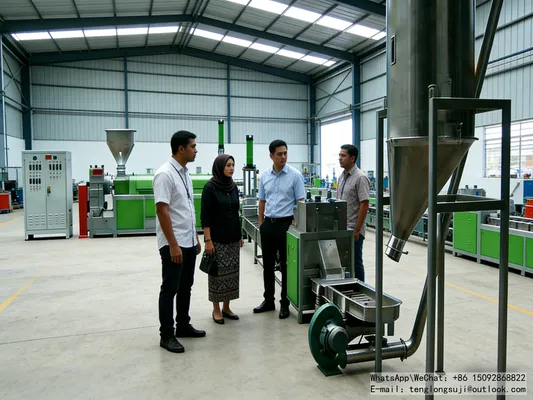
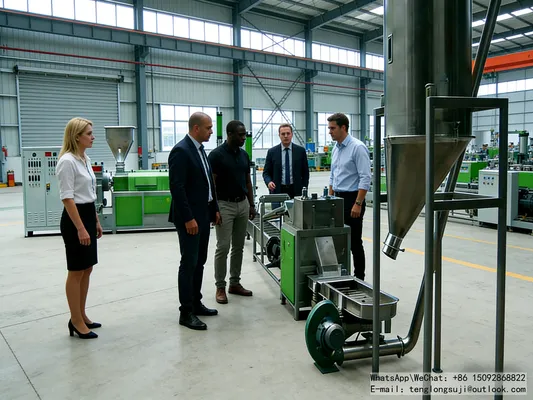
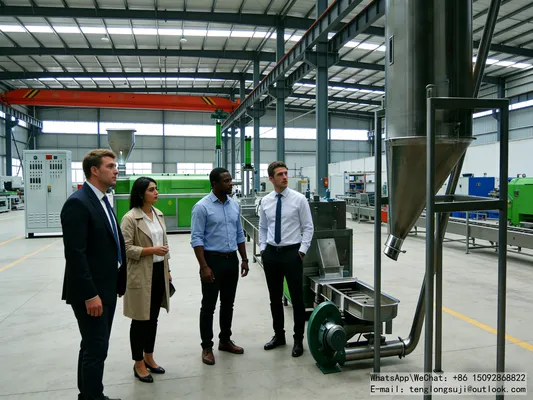
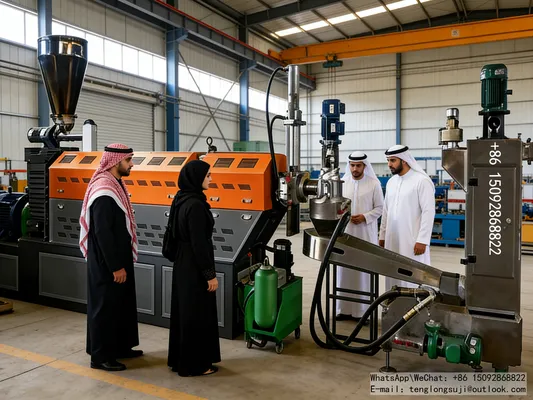
We customized the TL-G100 Agricultural Plastic Granulator—Nonthaburi’s top-selling model for agricultural film recycling—to address the unique challenges of processing farm-based LDPE waste:
- A forced feeding screw with an anti-bridging hopper, specifically designed to handle low-density LDPE films and prevent feeding jams, eliminating the need for manual intervention.
- A large-volume dual vacuum exhaust system that effectively removes 15% moisture and soil-related volatile gases, solving the foaming and porosity issues.
- A special LDPE screw design with a 34:1 L/D ratio, optimized for the plasticization of soft, flexible agricultural films.
- A self-cleaning screen changer that reduces downtime by 80%, cutting daily cleaning time from 2 hours to 15 minutes.
- An energy-efficient 37kW motor, tailored for processing wet agricultural films while reducing power consumption.
- A local service team based in Nonthaburi, offering same-day maintenance and support to minimize production interruptions during peak agricultural waste collection seasons.
The Results
Since installing the TL-G100 Plastic Granulator, Mr. Weerachai’s workshop has experienced a dramatic improvement in efficiency and profitability:
- Production output reached 520kg/h—a 136% boost—allowing him to process all 5 tons of daily agricultural film waste and expand his client base to 12 local farms and 2 agricultural cooperatives.
- Foaming and porosity issues were completely eliminated; the recycled LDPE granules are uniform, free of black spots, and suitable for reuse in agricultural mulch films and packaging.
- Daily cleaning time was reduced to 15 minutes, increasing machine uptime to >98%.
- Energy consumption dropped by 18%, translating to annual savings of 78,000 THBin electricity costs.
- The equipment supports Nonthaburi’s agricultural plastic recycling targets under Thailand’s BCG policy, earning Mr. Weerachai a reputation as a reliable, sustainable recycling partner for local farmers.

Plastic Granulator
Mr. Weerachai’s Quote: “This Plastic Granulator handles wet farm films perfectly—no jams, high output, and easy maintenance! It’s the best investment I’ve made for my business, and it’s helping Nonthaburi’s farmers reduce plastic waste.”
FAQ
- Q: How does the machine handle low-density LDPE agricultural films without jamming?
A: The forced feeding screw and anti-bridging hopper work together to ensure smooth, consistent feeding, even for light, flexible LDPE films that often jam standard granulators. - Q: Can the machine process LDPE films with 15% moisture content?
A: Yes, the large-volume dual vacuum exhaust system effectively removes excess moisture, producing dense, pore-free granules even when the feed material has a 15% moisture content.