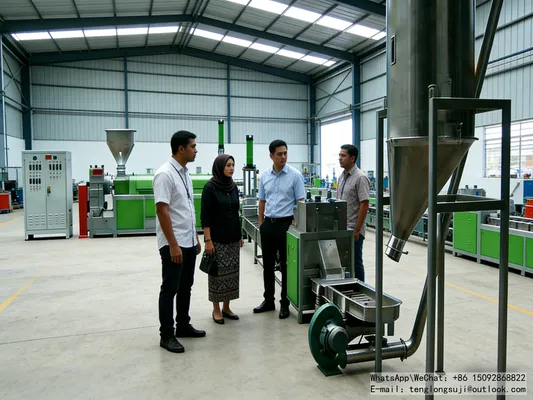
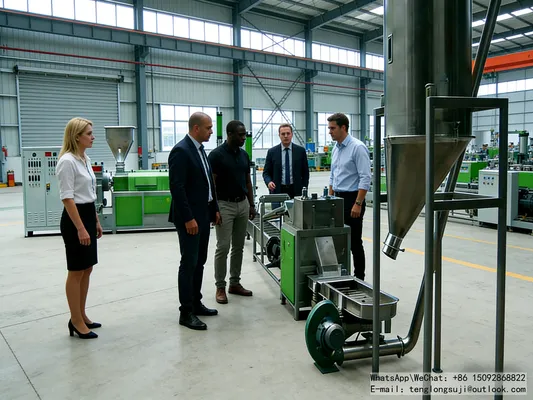
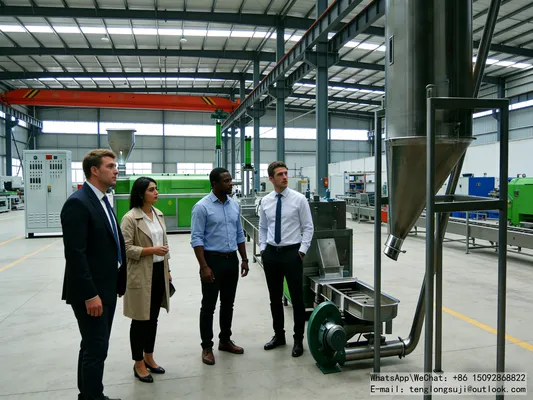
Mr. Ravi, a college-educated entrepreneur in Vijayawada, Andhra Pradesh, runs a large-scale plastic recycling plant with 40 employees. With 8 years of experience in the plastic recycling industry, he noticed that Andhra Pradesh’s plastic waste recycling rate stands at just 60%—leaving a large number of PET bottles to end up in landfills or rivers, causing severe pollution and wasting valuable resources. In 2024, he decided to expand his business by adding a plastic recycling machine to process PET bottles, aiming to capitalize on the state’s circular economy policy and meet the growing demand for recycled PET flakes. His plant’s proximity to Vijayawada’s port simplifies the import and export of recycled materials, further fueling his expansion plans.

Plastic Recycling Machine
The Challenge
Mr. Ravi’s main challenges in processing PET bottles centered on efficiency, pollution, and product quality. First, the traditional plastic recycling machine he considered required 6 operators to handle sorting, crushing, washing, and dehydrating—resulting in high labor costs (accounting for 45% of total operating expenses). Second, the inefficient washing system left 15% of the PET flakes with labels and adhesive residues, making them unsellable to textile and packaging factories. Third, the machine produced excessive noise (over 85 dB) and wastewater discharge, failing to meet the environmental standards set by the Andhra Pradesh Pollution Control Board. Compared to other suppliers, Mr. Ravi needed a full-automatic plastic recycling machine that could resolve these issues while ensuring environmental compliance, high efficiency, and consistent product quality.
The Solution
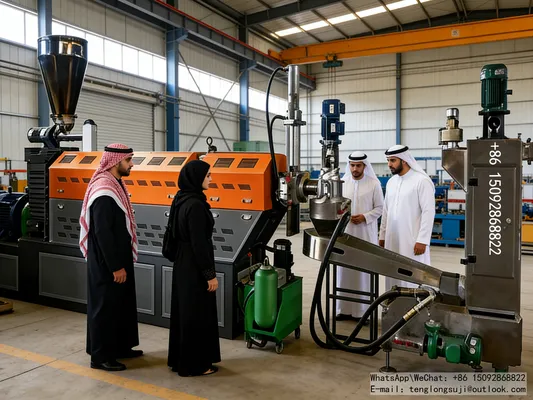
We provided a full-automatic plastic recycling machine (model: LGPET-500) customized for PET bottle processing, ideal for large-scale plants in Andhra Pradesh, with the following configuration and technical advantages:
- Integrated system combining sorting, crushing, friction washing, floating separation, and centrifugal dehydration—achieving full automation. Only 2 operators are needed to monitor the entire process, reducing labor costs by 67%.
- High-pressure friction washing machine with 3-stage cleaning, equipped with a label separator to remove 99.5% of labels and adhesive residues from PET bottles, ensuring flake purity.
- Noise reduction design (incorporating sound insulation cotton and shock-absorbing pads) to reduce noise to below 70 dB, complying with local environmental standards. A closed-loop wastewater treatment system recycles 90% of washing water, achieving pollution-free discharge.
- Technical parameters: Crushing capacity 500 kg/h, dehydration rate 98%, flake size 10-12 mm (adjustable). Equipped with an emergency stop button and fault alarm system for safe operation.
- Pre-sales: Professional program design tailored to his plant size and port logistics advantages. Post-sales: Free on-site installation, 1-year warranty, and quarterly on-site maintenance—more comprehensive than the 6-month warranty offered by local suppliers.

Plastic Recycling Machine
The Results
Since the plastic recycling machine was commissioned, Mr. Ravi’s plant has achieved impressive economic and environmental benefits:
- Processing capacity: Daily processing of 4 tonnes of PET bottles, producing 3.2 tonnes of high-quality PET flakes—meeting the demand of 3 local textile factories.
- Labor cost: Reduced from ₹180,000/month to ₹60,000/month, saving ₹1.44 million annually.
- Product quality: PET flake purity reached 99.5% with no residues, and the selling price increased by ₹8/kg—boosting monthly revenue by ₹64,000.
- Environmental compliance: Successfully passed the inspection of the Andhra Pradesh Pollution Control Board, avoiding environmental fines and enhancing the company’s reputation.
Mr. Ravi said: “This plastic recycling machine has exceeded my expectations! It’s fully automatic, pollution-free, and highly efficient, helping me reduce costs and improve product quality. With the support of the state’s circular economy policy, my business is thriving, and I plan to add another machine next year!”
FAQ
Q1: How much space does this plastic recycling machine require?
A1: It requires 150 square meters, suitable for large-scale recycling plants, and our team can adjust the layout according to your plant space.
Q2: Can the machine handle colored PET bottles?
A2: Yes, it can process both transparent and colored PET bottles, and the flake color can be sorted according to your needs.
If you run a large-scale plastic recycling plant in Andhra Pradesh, have you ever been troubled by high labor costs or environmental compliance? Leave your comments to discuss solutions!