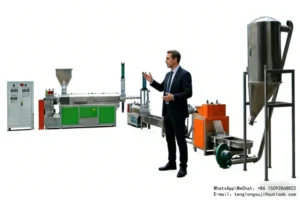
2026 is a pivotal year for global plastic recycling, with new environmental policies and regulations being implemented across major regions. These policies aim to reduce plastic pollution, promote circular economy, and raise the standards for recycled plastic products. As the core equipment in plastic recycling, the Plastic Pelletizing Machine must adapt to these regulatory changes to help enterprises comply with laws and access global markets. This article analyzes the latest international policies (EU, US, Asia) and how Plastic Pelletizing Machine manufacturers are optimizing their products to meet compliance requirements.

Plastic Pelletizing Machine
Key Global Environmental Policies Affecting Plastic Pelletizing Machine in 2026
- EU SUP Directive 2026 Update (Long-tail keyword: EU SUP compliant Plastic Pelletizing Machine)
The EU’s updated Single-Use Plastics (SUP) Directive, effective January 2026, imposes stricter requirements on recycled plastic content in packaging materials. Specifically, by 2026, all plastic packaging must contain at least 30% recycled content, and PET bottles must contain 50% recycled PET (rPET). To meet this requirement, Plastic Pelletizing Machine must produce high-purity rPET pellets with consistent quality.
Manufacturers have upgraded Plastic Pelletizing Machine with advanced sorting and decontamination systems to remove impurities (e.g., PVC, metal, paper) that affect pellet quality. Additionally, the equipment is equipped with online quality monitoring systems to ensure that rPET pellets meet the EU’s requirements for IV retention rate (≥90%) and impurity content (≤0.1%).
- US EPA Plastic Recycling Regulations 2026
The US Environmental Protection Agency (EPA) has launched the “Plastic Circular Economy Initiative” in 2026, providing tax incentives for enterprises that use advanced recycling equipment, including Plastic Pelletizing Machine. To qualify for incentives, the equipment must meet strict energy efficiency standards (energy consumption ≤40 kWh/ton of pellets) and reduce carbon emissions by 30% compared to traditional models.
In response, Plastic Pelletizing Machine manufacturers have integrated energy-saving technologies such as variable frequency drives (VFD) and heat recovery units. For example, a large-scale twin-screw Plastic Pelletizing Machine with VFD can adjust screw speed according to production demand, reducing energy waste by 15-20%.
- Asian Plastic Recycling Policies (China, Japan, South Korea)
China’s “14th Five-Year Plan for Plastic Pollution Control” (2026 update) requires that by 2026, the recycling rate of plastic waste will reach 35%, and the use of recycled plastic in packaging will account for 25%. To support this goal, the Chinese government provides subsidies for enterprises purchasing energy-saving Plastic Pelletizing Machine.
Japan and South Korea have also implemented similar policies, requiring recycled plastic products to meet GRS or ISCC certification. Plastic Pelletizing Machine in these regions are designed to produce pellets that meet the certification’s requirements for traceability and environmental impact.
How Plastic Pelletizing Machine Manufacturers Adapt to Policy Changes
- Certification Compliance: Manufacturers ensure that their Plastic Pelletizing Machinemeets international certifications such as GRS 4.0, ISCC, and REACH. This includes using food-grade materials, designing closed-loop production systems, and providing traceability documentation.
- Technological Upgrades: To meet the increasing demand for high-purity recycled pellets, Plastic Pelletizing Machineis equipped with advanced technologies such as laser sorting, electrostatic separation, and precise temperature control. These technologies improve the quality of recycled pellets and reduce environmental impact.
- Customized Solutions: Manufacturers offer customized Plastic Pelletizing Machinesolutions for different regions, adapting to local policy requirements. For example, EU-specific models focus on SUP compliance, while US models emphasize energy efficiency and carbon reduction.
Economic Impact of Policy Compliance for Plastic Pelletizing Machine Users
While complying with new policies requires additional investment in advanced Plastic Pelletizing Machine, it also brings significant economic benefits. Enterprises that use policy-compliant equipment can:
- Access high-value markets (e.g., EU, US) where recycled plastic products with high recycled content command a premium price (5-10% higher than non-compliant products).
- Qualify for government subsidies and tax incentives, reducing equipment investment and operational costs.
- Enhance brand reputation as an environmentally responsible enterprise, attracting more customers and partners.
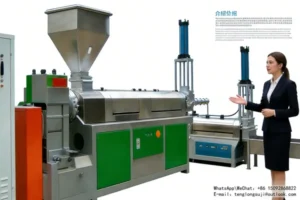
Plastic Pelletizing Machine
FAQ: Plastic Pelletizing Machine and Policy Compliance
- Plastic Pelletizing MachineQ: Do I need to upgrade my existing to comply with 2026 EU SUP Directive?
A: If your current machine cannot produce high-purity rPET pellets (IV retention rate ≥90%, impurity content ≤0.1%), you will need to upgrade the decontamination and quality monitoring systems. Most manufacturers offer upgrade services to avoid full equipment replacement. - Plastic Pelletizing MachineQ: How does GRS certification affect the selection of ?
A: GRS certification requires traceability of recycled materials, so the Plastic Pelletizing Machineshould be equipped with a production monitoring system that records parameters such as raw material input, processing temperature, and output. Additionally, the equipment must not cause secondary pollution. - Plastic Pelletizing MachineQ: Are there any subsidies for purchasing energy-saving in 2026?
A: Yes, many countries (e.g., US, China, EU) offer subsidies or tax credits for energy-saving industrial equipment. For example, the US EPA provides a 10% tax credit for enterprises purchasing Plastic Pelletizing Machinewith energy efficiency ≥15%. - Plastic Pelletizing MachineQ: What is the carbon reduction potential of advanced ?
A: Advanced models with heat recovery and VFD systems can reduce carbon emissions by 30-40% compared to traditional machines. For a medium-sized enterprise processing 1,000 tons of plastic per month, this translates to a reduction of 120-160 tons of CO₂ annually.