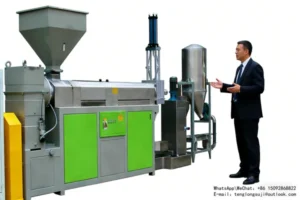
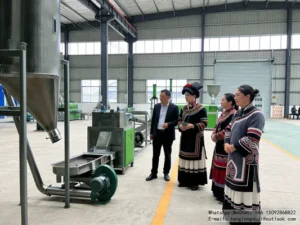
April 7, 2026 – As the global circular economy gains momentum, the Plastic Granulator has become an indispensable tool for plastic recycling operations, driven by stringent new environmental policies from the European Union (EU) and the United States. In 2026, the global Plastic Granulator market is valued at $880 million, with a projected CAGR of 5.2% through 2034—fueled primarily by regulatory pressure to reduce plastic waste and meet recycled content targets. This article explores how EU and US policies are reshaping the Plastic Granulator landscape, and what manufacturers and recyclers must do to comply and maintain a competitive edge.
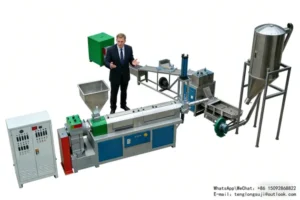
Plastic Granulator
EU PPWR 2026: New Mandates for Plastic Granulator Performance
The EU’s Packaging and Packaging Waste Regulation (PPWR) 2026—replacing the outdated 94/62/EC directive—introduces harmonized, stricter requirements for plastic packaging and recycling equipment across all member states. A key mandate specifies that 35% of all plastic packaging must contain recycled content by 2030, a target that directly relies on high-quality Plastic Granulator capable of producing pure, consistent recycled plastic (rPlastic) pellets. Additionally, the PPWR requires Plastic Granulator to achieve a Decontamination Efficiency of ≥98% to eliminate contaminants such as ink, labels, and food residues from post-consumer plastic waste.
To enforce these standards, the EU has implemented a robust compliance framework that penalizes businesses using non-compliant equipment. For instance, a French recycling facility was fined €28,000 in early 2026 for using an outdated Plastic Granulator that failed to meet decontamination requirements. Conversely, facilities using Plastic Granulator equipped with advanced washing systems—including Centrifugal Separator and high-speed friction washers—are eligible for EU sustainability grants of up to €20,000.
US EPA’s 2026 Recycling Initiative: Incentivizing Energy-Efficient Plastic Granulator
In the United States, the Environmental Protection Agency (EPA) launched its 2026 “Plastic Recycling Infrastructure Boost” initiative, which offers tax incentives for businesses investing in energy-efficient Plastic Granulator. Under this program, businesses can claim a 10% tax credit for purchasing Plastic Granulator that reduce energy consumption by ≥15% compared to traditional models. The initiative also mandates that all federally funded recycling facilities use Plastic Granulator equipped with Heat Recovery Unit to minimize carbon emissions.
Key technical requirements for Plastic Granulator to qualify for US incentives include a variable-frequency drive (VFD) system, automated contaminant detection, and a 特性粘度 (IV) 保留率 of ≥85% to ensure rPlastic maintains its mechanical properties. A mid-sized recycling facility in Texas recently upgraded to an energy-efficient Plastic Granulator and reported a 17% reduction in monthly energy costs, along with a $12,000 tax credit.
Key Adjustments for Plastic Granulator to Meet 2026 Policy Standards
- Upgrade decontamination systems: Integrate Centrifugal Separatorand multi-stage washing processes to achieve ≥98% Decontamination Efficiency.
- Adopt energy-saving technologies: InstallHeat Recovery Unitand VFDs to reduce energy consumption by ≥15% and qualify for tax incentives.
- Implement traceability systems: Equip barcode or RFID technology to track raw materials and finished rPlastic pellets, meeting EU and US recycled content verification requirements.
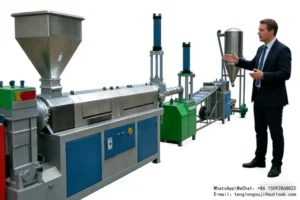
Plastic granulator
FAQ: Plastic Granulator and 2026 Global Policies
- Q: Can existing Plastic Granulator be upgraded to meet 2026 EU and US policies?
A: Yes, most older machines can be upgraded by adding key components like Centrifugal Separatorand Heat Recovery Unit, which is more cost-effective than purchasing new equipment. - Q: What happens if a Plastic Granulator does not meet PPWR requirements?
A: Businesses face fines of up to €50,000 in the EU, and their rPlastic products may be banned from the EU market. In the US, non-compliant machines are ineligible for tax incentives and federal funding. - Q: How do policies affect the price of Plastic Granulator?
A: Policy-compliant Plastic Granulatorare 12-18% more expensive upfront, but the long-term savings from incentives and energy efficiency offset the initial investment within 6-12 months.